5 Dangerous Gym Mistakes That Can Cause a Pectoralis Tendon Tear
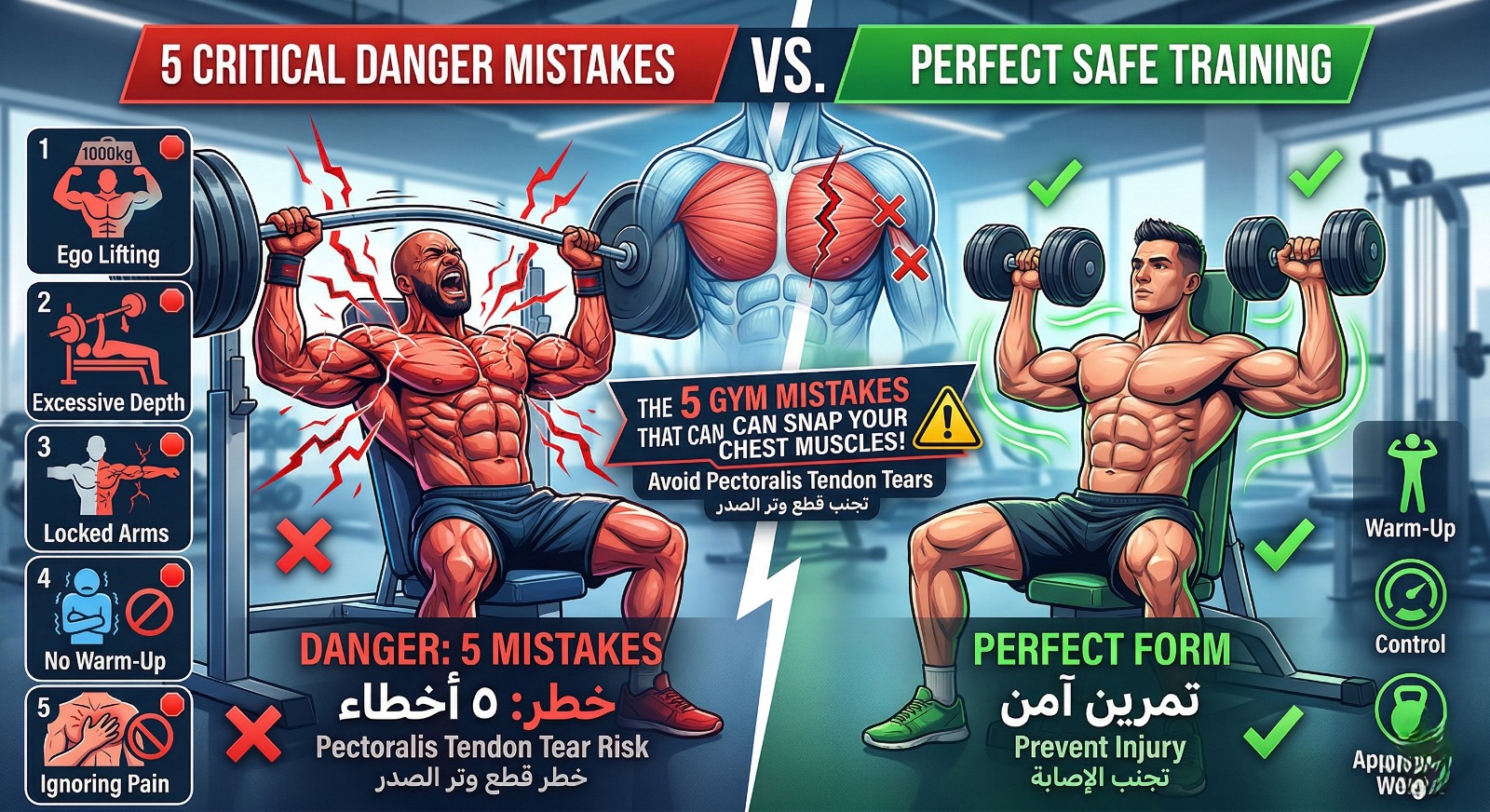
The Hidden Danger in Your Chest Workout
Imagine this common scenario: You are at the gym, feeling great, and pushing for a new personal record on the bench press. Suddenly, without any prior warning, you feel a sharp "pop" in your chest or shoulder. You rack the weight, but you can barely lift your arm. This is the terrifying reality of a Pectoralis Major Tendon Tear, a severe injury that sidelines countless athletes and gym-goers every year.
As a sports injury, this trauma often occurs when the tendon connecting the large chest muscle (pectoralis major) to the upper arm bone (humerus) is subjected to extreme, unnatural tension. The most frustrating part? It is almost entirely preventable. Let's break down the 5 critical mistakes that lead to this injury and how you can protect your muscles and joints.
The 5 Major Mistakes That Destroy Your Chest Tendons:
1. Lifting Weights Beyond Your Physical Capacity (Ego Lifting)
This is the leading cause of gym injuries. When you load the bar with more weight than your muscle fibers can mechanically handle, the load is dangerously shifted onto the connective tissues and tendons. Tendons are strong, but they do not have the same elastic properties as muscles. When forced to bear an unmanageable load, they snap.
2. Going Too Deep on the Bench Press or Dumbbell Flyes
While a full range of motion is generally good for muscle hypertrophy, taking it to the extreme under a heavy load is a recipe for disaster. Dropping the weight too deep stretches the chest muscle and tendon past their safe physiological limits. In this vulnerable, overstretched position, the tendon is at its weakest and most prone to rupturing.
3. Fully Extending or Locking Out Your Arms
Many lifters make the mistake of completely locking out their elbows at the top of a press or maintaining straight arms during dumbbell flyes. This biomechanical error takes the tension off the chest muscle and forces the elbow joints, shoulders, and chest tendons to absorb the sheer force of the weight.
4. Skipping a Proper Dynamic Warm-Up
Muscles and tendons have viscoelastic properties—they perform better and stretch safely when they are warm and filled with blood. Jumping straight into heavy sets with "cold" tissues makes them brittle and stiff. A proper warm-up increases blood flow and elasticity, acting as a crucial shock absorber for heavy lifts.
5. Ignoring Pain or "Pinching" Sensations
No severe injury happens entirely out of the blue. Often, lifters experience a sharp, localized pain, a pinching sensation in the front of the shoulder, or tightness in the chest before the actual tear occurs. Ignoring these warning signs and pushing through the pain turns minor micro-tears into a catastrophic complete rupture.
How to Recognize a Pectoralis Tear
- A sudden tearing sensation or audible "pop" during a lift.
- Immediate, severe pain in the chest and front of the shoulder.
- Rapid bruising and swelling across the chest and arm.
- A visible deformity or "dent" in the chest muscle where it has retracted.
- Profound weakness, especially when trying to push your arms forward.
How to Protect Yourself and Train Smart
The solution requires discipline and a smart approach to biomechanics. First, lighten the weight to a level where you can control the entire movement. Second, control the eccentric phase (the lowering portion of the lift) rather than letting gravity drop the weight. Limit your depth so your elbows do not drop excessively far below the bench line. Finally, always dedicate 5 to 10 minutes to a dynamic warm-up targeting the rotator cuffs and chest before touching heavy weights.
Train for longevity, listen to your body, and never let your ego dictate your workout. Share this guide with your training partners to keep them safe and injury-free!